
Fabricated Frames
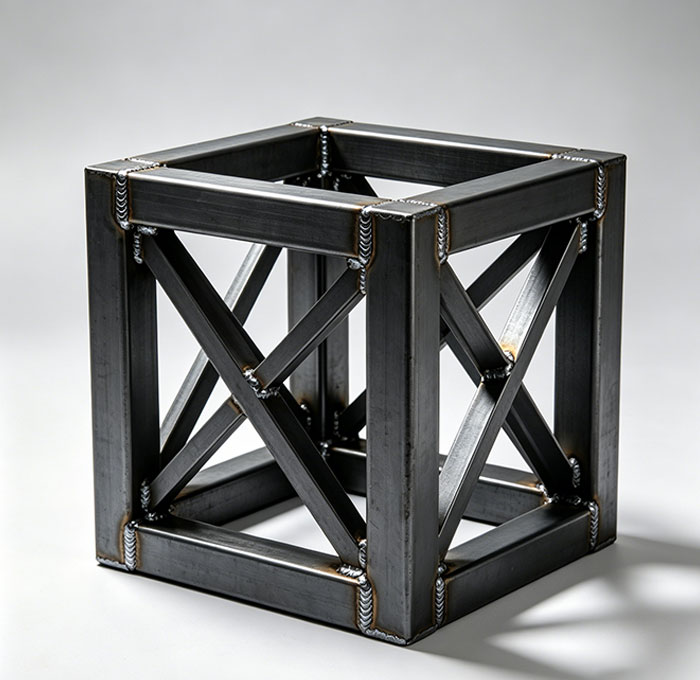
Complex metal components that form the main skeleton of equipment or systems. Multi-part assemblies carrying primary loads and providing structural stability.
- High rigidity & large size
- Welding-dominant fabrication
Typical Features
Irregular shapes; polyhedron / frame / shell combinations; welding-dominant; large in size and high in rigidity.
Irregular Shapes
Non-regular geometries with function-first design.
Frame / Shell Combinations
Polyhedron, frame and shell assemblies.
Welding-Dominant
Assembled mainly by welding.
Large & Rigid
Large dimensions with high structural rigidity.
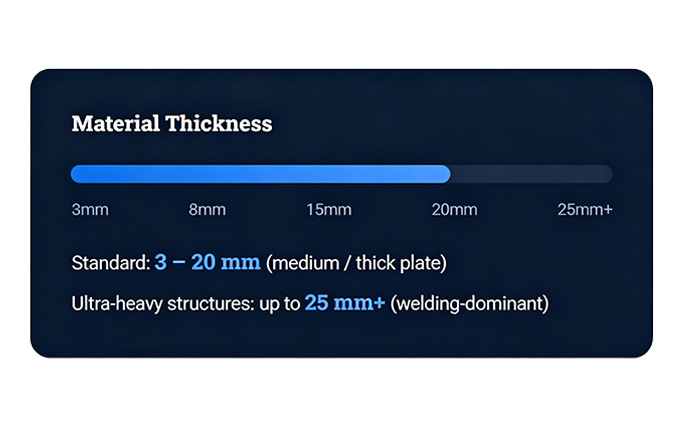
Material Thickness & Core Materials
Carbon Steel
Core material for frames and structural components.
High-Strength Steel
Higher strength for load-bearing equipment bases.
Stainless Steel
Anti-corrosion frames for demanding environments.
Key Quality Points
Dimensional Tolerance Control
Overall dimensional tolerance accumulation control.
Welding Deformation Control
Controlled deformation throughout the welding process.
Weld Strength & Inspection
Weld strength verified through inspection (NDT).
Dynamic Load Testing
Dynamic load testing to verify structural performance.
Surface Treatment Adhesion
Adhesion ensured by thick-plate sandblasting before coating.
Value-Added Sources
DFM Optimization
DFM optimization at the design stage.
Welding Procedure Qualification
Qualified welding procedures (WPS / PQR).
NDT Reports
Non-destructive testing reports.
Overall Machining Precision
Precision machining of the finished structure.
One-Stop Assembly
One-stop assembly & delivery.
FAQs
Our fiber laser cutting system handles maximum material thickness of 60mm with work area up to 10000mm × 2000mm. This applies across carbon steel, stainless steel, aluminum, copper, and brass—achievable thickness varies by material and cut quality requirements. Positioning accuracy: ±0.05mm. Typical cutting tolerance: ±0.1mm for thin plate, ±0.2mm for thick plate. Cut samples provided for your evaluation.
Following laser cutting, our CNC press brake bending handles carbon steel up to 20mm, stainless steel up to 16mm, and aluminum up to 16mm, with maximum bending length of 6000mm. Laser cutting and bending operate as integrated processes—cut profiles are optimized for smooth production. Minimum flange height and inside bend radius depend on material grade and thickness; we review all designs to ensure manufacturability before production.
Available finishes: powder coating, wet painting, electroplating (zinc, nickel, chrome), anodizing (aluminum), brushing, polishing, passivation. For visible parts, we implement protective handling, standardized lighting inspection, and protective film application before shipment. Standard RAL colors available; custom color matching supported.
Our standard process includes: (1) Design review for production feasibility;
(2) First-article sample with dimensional report for approval;
(3) In-process checks at each stage;
(4) Final inspection per drawing tolerances;
(5) Inspection report and material certificate included with shipment.
Samples available for all new designs. Typical lead time: 5–10 working days (sheet metal), 7–15 days (machined components), depending on complexity. We provide photo confirmation and dimensional report before mass production. Sample cost deducted from first production order.
Start Your Custom Sheet‑Metal & CNC Project
One‑stop manufacturing from prototyping to assembly. All drawing files kept confidential.